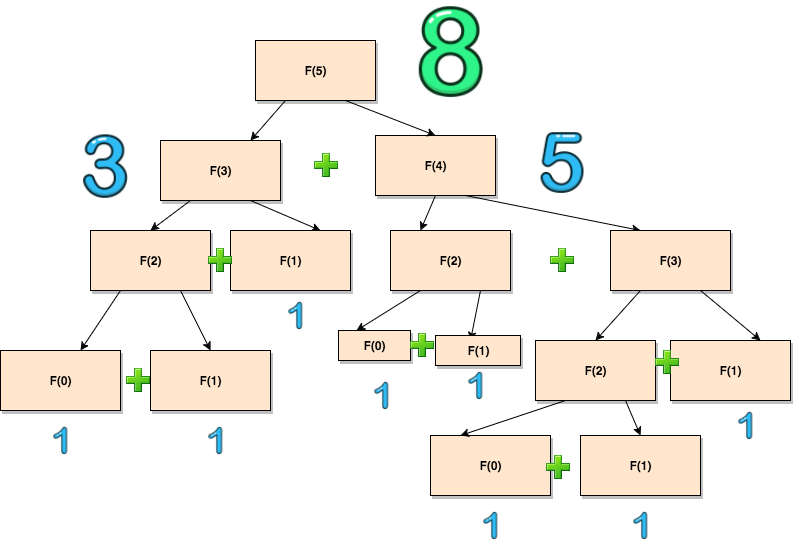
fibonacci <- function(n, a, b) {
  stopifnot(is.numeric(n), n >= 0)
  if (n == 0) return(a)
  if (n == 1) return(b)
  return(fibonacci(n-1, a, b) + fibonacci(n-2, a, b))
}

fibonacci(10, 1,1)
[1] 89[1] 1213932026-01-27
the prototypical function - similar to proof by induction:
define values for endings
get value for f(x) from value of f(x-1)
Implement a recursive function fibonacci (n, a, b) that calculates the \(n\)th fibonacci number using starting values \(a\) and \(b\):
The Fibonacci series is defined as: \[ \begin{eqnarray*} x_1 &=& a,\ \ x_2 = b\\ x_n &=& x_{n-2} + x_{n-1} \ \text{ for } n \ge 3 \end{eqnarray*} \]
Functions with multiple calls (tree recursions) to themselves are inefficient and run the risk of stack overflows
fibonacci_seq <- function(n, seq = c(a, b)) {
  stopifnot(is.numeric(n), n >= 1)
  if (n == 1) return(seq[1])
  if (n == 2) return(seq)
  return(
    fibonacci_seq(n-1,
      seq = c(seq, seq[length(seq)] + seq[length(seq)-1]))
  )
}

fibonacci_seq(25, seq=c(1,1))
[1] 1 1 2 3 5 8 13 21 34 55 89 144
[13] 233 377 610 987 1597 2584 4181 6765 10946 17711 28657 46368
[25] 75025Operators in R, such as +, -, *, ^, … are defined as infix functions and equivalent to functions of the form `operator`(el1, el2)
This also means that they can be overwritten …
We can define + between two strings as concatenation:
Some functions e.g. names are allowed on the left hand side of an assignment:
There are two implementations of this function: names and names<-
The second function is called for replacements, such as the one above.
Equivalently, we could have called it as:
Which other replacement functions can you think of?
Check with apropos("<-")